If it is simplified in a way that is accessible to many, moving image texts really come in essentially two differing flavours. Single Camera and multi camera techniques. Neither of these are perfect by any means, however, in this post I will be focusing purely on single camera productions and what they en-tale and what exactly it takes to produce a single camera production.
How is the camera used and the footage shot?
To begin with single camera productions were the norm in movie production due to there being no way to synchronize multiple cameras at one time. So originally single cameras were seen as a limitation but over time producers and directors have unearthed the positives of using it and it is still commonplace in the industry to use a single camera.
Using a single camera is more time consuming than using multiple cameras but it does offer the best opportunity to maximize artistic flair in the production.
Each scene is filmed separately and is shot multiple times until the director is eventually satisfied with what has been shot.
This allows the Actors, lighting directors, makeup artists and audio people to focus on at one time, this is once again more time consuming but does allow for a more refined final product.
The camera is essentially put in one place and that one camera is used for every single shot and everyone focuses on this and puts their time and effort into it. This as previously stated is time consuming but produces exactly what the director intends to.
A prime example of a single camera production is: The Office.
Here is a clip of this in action.
How is a single camera production lit?
Single camera productions are usually lit using the '3 point lighting system' this is where 3 lights are placed around the person or object who is in shot, and placed in a certain way, this is when 2 lights are either side of the camera and one extra light behind the subject which ensures that they're in the shot as clear as possible. Single camera productions are much easier to light than their multi camera counterparts. This is due to each of their shots being done seperately, which means that if one set up isn't working then it can be shot as many times as needed until the required shot is achieved
What are the advantages/disadvantages of sound in single camera?
Sound in single camera productions offers more flexibility due to it being easy to edit in post production. Since there are multiple takes of a single shot the editor has a lot of freedom to edit and can take sounds from each shots and put them into the final piece, they can also place sounds in from other sources into the final piece to make once engaging, final shot, this is easier to do and in much more refined detail due to it only being on one piece. This is a big positive for the sound crew and editing team as they are able to focus all of their time and effort into one piece and make that one piece perfect. On the other hand, multi camera productions aren't able to do this as they have alot more issues to worry about and often the sound is hindered by this as they have multiple cameras and often characters to worry about in every single scene so often there may be several problems with sound that will need to be tinkered with in post production.
However, sound in single camera productions does have it's drawbacks, as there's only one camera it can be hard to hide to get the correct audio quality, however these issues can be tampered with in post production, some of the audio quality may however be lost in the process.
How is a single camera production edited?
A single camera production is very difficult to edit, this is due to the fact that a 5 minute scene can often have over an hours worth of footage in it, this will need to be cut down and have all the sound and video altered in the editing which is a very time consuming process. Therefore the editorial team have alot of work to do, but however it is easier to edit than multi camera productions due to there being multiple cameras, audio channels and other things to incorporate. In that respect, single camera productions are easier to edit.
Monday, 8 February 2016

Friday, 15 January 2016
Tuesday, 12 January 2016
Assessment Feedback
U5
First submission
GC1
You have described some of the requirements of working to a brief and you have attempted to reference your own experiences in order to reflect on brief work.
GC2
You have planned a response to a specified brief showing creativity and imagination based on research you have conducted into the client and the target audience. You have only had occasional assistance and your idea is perfectly suited to your target audience. Pre-production paperwork must be uploaded.
GC3
You have applied a response to a brief which shows imagination and a competence in animation. Your product suits the specified audience and is fit for purpose. You had only occasional assistance.
GC4
You have explained your own work and processes of working on completion of a specified brief and you have referenced examples from your experiences. You have touched on constraints and industry practice but this is underdeveloped.
Resubmission
GC1
You have explained the requirements of working to a brief and you have referenced some specific examples of/from real briefs and also your own experiences.
Wednesday, 16 December 2015
Understand the Requirements of Working to a Brief
Briefs:
What is a brief/project brief?:
A brief is a set of directions or a request which an applicant can respond to. The client will create the brief and then either give it to the person who will create the response or advertise it so that numerous people can respond. The result should be a product for which the applicant / worker can get recompense / payment or recognition. The brief is the first part of the process as it has be able to detail just what is happening but it also has to be short and concise enough for the client not to become overwhelmed or disinterested in what they are reading which would therefore be detrimental to the entire project as a whole. It is also useful to ensure that the brief they are handed is lenient enough for them to take their own interpretations of it and implement their own artistic flair to it.

What is a commission?:
Commissioning is where a client will reach out to a certain group of individuals or a single individual and ask them to complete a job for them, this happens in media when a company wants someone to produce a movie for them, they will often decide who to commission after viewing all of the briefs given to them they have to decide which one to commission and take the idea further. They decide which idea to commission judged by the strength of a brief so for the people producing the brief it is vital that they have made it as short and concise but also full of information as possible as this is vital for the brief to be selected over the other ones. Once your brief is chosen this is known as being 'commissioned' once your item has been commissioned it is then down to the people who have purchased it as to what happens with it, ensuring that the main part of the product/project isn't lost but also adding their own thoughts and opinions to it due to the fact that they are the ones who have invested into it.
Tender:
A tender is different to a brief, the client and or employer will reach out to people with an 'open brief' and look to allow them to have their own thoughts and opinions and make any changes in which they see necessary to have it the way in which they want. This information is then relayed to the original creator of the brief and if they feel this is acceptable they will then look to sell it with the changes in so that both parties end up benefiting.
Another way someone can respond to a brief is if the brief happens to be issued in the rules of a competition, a fantastic example of this would be the EStings we created, we had to follow a brief which was in the rules of the ESting competition to ensure that our entries would be eligible, here is an extract in he rules in which we had to follow:

In terms of finding ways to 'work around' the brief there wasn't too many, especially with the fact that it had to be exactly 10 seconds long, no longer, no shorter which meant that it was a reasonably strict brief (in that regard) however we managed to hit this brief with relative ease in the end due to the fact that things can always easily be added/taken away with the idea we decided to use to meet the project brief. I had the opportunity to liaise with my tutor in the same way I would a client even though soe briefs allow very little room for negotiation. It was suggested that we look at a comic way to incorporate a bomb so that it was not seen as insensitive due to current and topical events. We achieved this by using sticks of dynamite in a nod to old Warner Bros cartoons.
There are many varying restrictions and implications in which people could come across when responding to a brief, some of which may not even be specified in the actual brief itself, one of the main problems is copyright, especially with the constant access to the internet, it's vital to stay savvy when exploring options online as if you wish to use work for professional use and you have 'stolen' someone else's work unknowingly when your work can be claimed and taken away from you. This was easily avoided with the ESting task as all sounds had to be taken directly from the E4 site, furthermore, all footage had to be made and produced by you from scratch so copyright laws were fairly easy and reasonable to abide by in this certain scenario.
Also, the competition rules had to be followed as this animation was ultimately made to be shown on national TV this in turn means that OFCOM's rules and regulations also have to be followed to ensure that is suitable for TV.
I had to make a few changes to my project during production, this is due to the 10 second deadline being an extremely strict one and we went out and obtained over 200 shots which would of been over 50 seconds of footage this lead us to tweak our idea slightly and cut out some parts, to any usual viewer from a neutral perspective it would appear that nothing really changed but for us the idea is just a shell of what it was in the beginning, even if we were still happy with it.
On the other hand, if your'e working on a bigger scale your budget may change very quickly and either your idea or certain aspects of your movie have to be changed to ensure that it can still be made with the budget at hand, alternatively, the budget could change for the better which allows the team more freedom to produce more impressive ad in-depth shots.


What is a brief/project brief?:
A brief is a set of directions or a request which an applicant can respond to. The client will create the brief and then either give it to the person who will create the response or advertise it so that numerous people can respond. The result should be a product for which the applicant / worker can get recompense / payment or recognition. The brief is the first part of the process as it has be able to detail just what is happening but it also has to be short and concise enough for the client not to become overwhelmed or disinterested in what they are reading which would therefore be detrimental to the entire project as a whole. It is also useful to ensure that the brief they are handed is lenient enough for them to take their own interpretations of it and implement their own artistic flair to it.

A tutorial helping people to create a great project brief:
What is a commission?:
Commissioning is where a client will reach out to a certain group of individuals or a single individual and ask them to complete a job for them, this happens in media when a company wants someone to produce a movie for them, they will often decide who to commission after viewing all of the briefs given to them they have to decide which one to commission and take the idea further. They decide which idea to commission judged by the strength of a brief so for the people producing the brief it is vital that they have made it as short and concise but also full of information as possible as this is vital for the brief to be selected over the other ones. Once your brief is chosen this is known as being 'commissioned' once your item has been commissioned it is then down to the people who have purchased it as to what happens with it, ensuring that the main part of the product/project isn't lost but also adding their own thoughts and opinions to it due to the fact that they are the ones who have invested into it.
Tender:
A tender is different to a brief, the client and or employer will reach out to people with an 'open brief' and look to allow them to have their own thoughts and opinions and make any changes in which they see necessary to have it the way in which they want. This information is then relayed to the original creator of the brief and if they feel this is acceptable they will then look to sell it with the changes in so that both parties end up benefiting.
Another way someone can respond to a brief is if the brief happens to be issued in the rules of a competition, a fantastic example of this would be the EStings we created, we had to follow a brief which was in the rules of the ESting competition to ensure that our entries would be eligible, here is an extract in he rules in which we had to follow:
Above
is the rules listed on the EStings website for the competition. This is the
brief that we had to explicitly follow for our animations. In regards to the
rules, there wasn't an abundance of them so there was a reasonable amount of
freedom when producing the ESting, the main draw back with an ESting however is
the 10 second maximum time allocated for you to work with, furthermore we were
unable to use our own sounds in which we had sourced from the internet which
was abit of a hindrance in the end for our final product.
In terms of finding ways to 'work around' the brief there wasn't too many, especially with the fact that it had to be exactly 10 seconds long, no longer, no shorter which meant that it was a reasonably strict brief (in that regard) however we managed to hit this brief with relative ease in the end due to the fact that things can always easily be added/taken away with the idea we decided to use to meet the project brief. I had the opportunity to liaise with my tutor in the same way I would a client even though soe briefs allow very little room for negotiation. It was suggested that we look at a comic way to incorporate a bomb so that it was not seen as insensitive due to current and topical events. We achieved this by using sticks of dynamite in a nod to old Warner Bros cartoons.
There are many varying restrictions and implications in which people could come across when responding to a brief, some of which may not even be specified in the actual brief itself, one of the main problems is copyright, especially with the constant access to the internet, it's vital to stay savvy when exploring options online as if you wish to use work for professional use and you have 'stolen' someone else's work unknowingly when your work can be claimed and taken away from you. This was easily avoided with the ESting task as all sounds had to be taken directly from the E4 site, furthermore, all footage had to be made and produced by you from scratch so copyright laws were fairly easy and reasonable to abide by in this certain scenario.
Also, the competition rules had to be followed as this animation was ultimately made to be shown on national TV this in turn means that OFCOM's rules and regulations also have to be followed to ensure that is suitable for TV.
I had to make a few changes to my project during production, this is due to the 10 second deadline being an extremely strict one and we went out and obtained over 200 shots which would of been over 50 seconds of footage this lead us to tweak our idea slightly and cut out some parts, to any usual viewer from a neutral perspective it would appear that nothing really changed but for us the idea is just a shell of what it was in the beginning, even if we were still happy with it.
On the other hand, if your'e working on a bigger scale your budget may change very quickly and either your idea or certain aspects of your movie have to be changed to ensure that it can still be made with the budget at hand, alternatively, the budget could change for the better which allows the team more freedom to produce more impressive ad in-depth shots.

Briefs are fantastic for people who are just finding their way in the industry as they offer a fantastic way to obtain credibility and experience, if it is a commission based brief then it allows the person to obtain money and therefore explore other ventures within the industry as well. Which further supports the fact that briefs are fantastic for helping people in the industry
 |
| Brief example from Hiive (formerly Creative Skillset) |
During this task I had several opportunities to learn new skills and develop the skills I already had further, this one was specifically helpful for me due to the fact that I had never worked using stop-motion animation in the past so this was a whole new skill to me which I feel helped to develop my skills and know how greatly.
I completed alot of new tasks in which I had never done before when responding to the brief at hand, working frame by frame was perhaps the most challenging thing in which I learnt how to carry out, this is due to he fact that during my time on the course I had only worked with full blown video production so making an animation through stop-motion was always going to be a new thing and something in which I would have to take my time to get used to. Furthermore, we worked with Manual DSLR cameras something in which I had never done before carrying out this project and I feel much more comfortable using this type of camera.
There were a few varying skills in which we had to sue in this project, perhaps the hardest part was ensuring that when I was sliding on the floor was flawless and looked smooth as if it jumped or one frame was missed then the illusion that it was as if it was being recorded would be lost so we took extra care when producing these and was perhaps the hardest thing in which I have carried out on the entire course in terms of ensuring that it was just right and I am happy with how this turned out and if I was to replicate this in the future.
The contribution that I made to the project was my completed animation which was of course the 10 second Esting stop motion animation in which will be sent off to Channel Four and hopefully be considered for the ESting competition, however this also had contributions to me personally in terms of developing my own skills and helping me further develop my ability not only with a camera but also in front of it and editing and making tough decisions choosing exactly which parts need to be cut out.
Wednesday, 2 December 2015
Animation Evaluation
How will I be reviewing my piece of work?:
To review my piece of work I will be creating a written report, this is due to the fact that I can put all opinions that I feel about it back in at any time in an easy to do manner, this is something which I wouldn't be able to do with a video commentary or oral presentation, due to the fact that once they're done, they're done, whereas with a written review I can chop and change whenever I wish to, something which I like to have when reviewing my work.
How did I exhibit my work?:
I exhibited my work through YouTube, this is due to the fact that it is a platform for people to showcase their work to the world without having to spend money to have it shown to people, so YouTube is the best platform for our independent work to be shown. This is no the only way for us to share this video, we also could of shared it for free via Facebook/Twitter and other social media sites, however, with YouTube we're able to see how long people have viewed our work for and other things which allow us to review how well the video has gone which is key for reviewing analytics etc.
Here is our ESTing directly from YouTube:
I made a survey on the site: SurveyMonkey to get some feedback on: DE4usion, here are the results and what they meant in terms of our project:
Question 1:

From these responses I got it's clear that the respondents also feel the key demographic is Teenagers and young adults as combined they take up 80% of the respondents votes with 16/20 20 of the responses selecting them together. This is perfect in terms of feedback as it means that we met our target demographic in terms of age range which is always key so that it gets the correct response in which it was intended to.
Question 2:



For: What Animation Type Was Used? we also received very encouraging responses with 85% of respondents giving us the response in which we were looking for which is key when receiving feedback. However, we really would of like 100% of respondents to of put Live Action due to this one being pretty obvious, this can be down to people trying to be humorous and put the wrong responses in and therefore causing anomalies so this can't be read into too much. What is key is that the vast majority noticed it was live action which is great.
Question 4:


To review my piece of work I will be creating a written report, this is due to the fact that I can put all opinions that I feel about it back in at any time in an easy to do manner, this is something which I wouldn't be able to do with a video commentary or oral presentation, due to the fact that once they're done, they're done, whereas with a written review I can chop and change whenever I wish to, something which I like to have when reviewing my work.
How did I exhibit my work?:
I exhibited my work through YouTube, this is due to the fact that it is a platform for people to showcase their work to the world without having to spend money to have it shown to people, so YouTube is the best platform for our independent work to be shown. This is no the only way for us to share this video, we also could of shared it for free via Facebook/Twitter and other social media sites, however, with YouTube we're able to see how long people have viewed our work for and other things which allow us to review how well the video has gone which is key for reviewing analytics etc.
Here is our ESTing directly from YouTube:
I made a survey on the site: SurveyMonkey to get some feedback on: DE4usion, here are the results and what they meant in terms of our project:
Question 1:

Question 2:


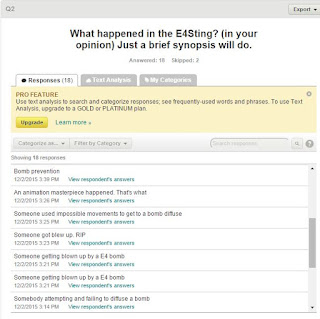
Due to this question receiving Qualitative data responses there was a wide range of answers which meant that it's hard to show that these answers are hard to generalize to wider society, however, most of the answers did get the plot perfectly which was great to see as it was one of our main concerns when making it, due to the fact that we actually had 30 seconds worth of footage which had to be cut down to 10 seconds so we had to make sure the plot was kept in tact as if it wasn't then it wouldn't of made any sense at all.
Question 3:

For: What Animation Type Was Used? we also received very encouraging responses with 85% of respondents giving us the response in which we were looking for which is key when receiving feedback. However, we really would of like 100% of respondents to of put Live Action due to this one being pretty obvious, this can be down to people trying to be humorous and put the wrong responses in and therefore causing anomalies so this can't be read into too much. What is key is that the vast majority noticed it was live action which is great.
Question 4:

In terms of Question 4 we weren't certain whether 10 seconds was enough time for people to develop a connection to the character, also the fact that it's in a light hearted way also indicates that the character and audience wouldn't have a strong connection with the character, we understood this. Although, it seems that the respondents to the questionnaire felt that there was a slight connection to the character with 85% of the respondents stating that they felt some sort of connection to the character. This is an added bonus for us as it meant that the viewers felt something to the character which adds to their connection to the piece as a whole.
Question 5:

For the responses in regards to whether or not the animation ran in a smooth manner it was clear that it didn't run entirely smooth, however, the responses were very positive with not one person selecting 'No' which is great to see however, if we were to do this again we would of taken less footage therefore leaving us in a situation in which we had to cut less of the photos which would of allowed it of flown in a much smoother manner.
Question 6:
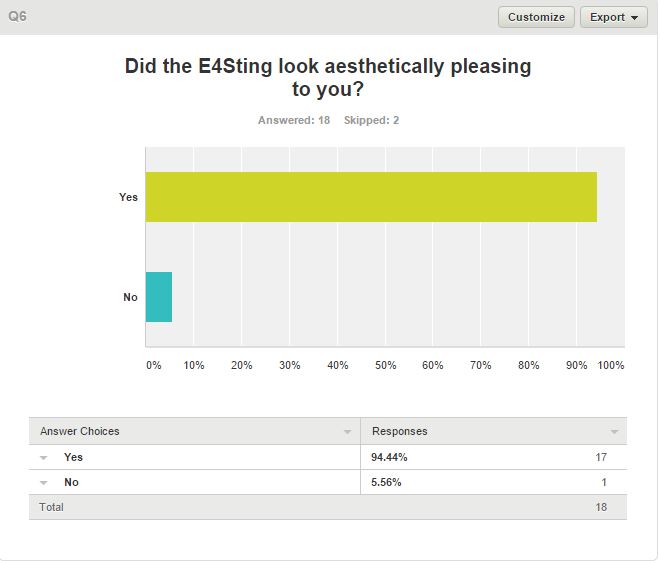
This is a very pleasing response pool due to us looking to ensure it was not only flowing well but that it was pleasing to the eye and it seems like we have achieved that with the survey responses which is great to hear.Only 1 respondent selecting 'no' which is really great to see, however, I feel we should of added more colour to the piece, although, it was hard with our location.
When producing our ESting we encountered some constraints when doing this, the issues were involved with copyright, this is because the E4 rules specifically stated that we were only able to use content from their site and using any other content would mean that our work would be made redundant. Furthermore, any sounds downloaded from the internet would ultimately be likely to be copyrighted anyway which would not be ideal at all and would once again leave any work that we had down to be made redundant.
Time management was not really too much of an issue for us and we actually ended up 'finished' a couple of days before the deadline, this allowed us to go back through our work and add some more touches to it and round off any edges that there were in our work and all in all make the final piece, so thankfully time management was one of our strong points throughout this task which was extremely helpful for us in the task.
If there was anything that we could of done with our time management better, I feel it would of been to re-take some of our shots just for the final product to end up better as a whole, but other than that I'm happy with how it all turned out in regards to the use of time.

Above is a man chunk of the brief in which we given from E4, we managed to comply with all of the rules and regulations set here which allowed our final product to be eligible to enter the whole competition if we see fit, which is great to know from our perspective that we did meet the regulations. To ensure that we did this, whenever we had another idea or before we were about to shoot the next section of our ESting we checked the brief thoroughly to ensure that we didn't go off the task which turned out to be the reason the kept in line with the brief which is always important when carrying out a task like this one.
In regards to feedback, we obtained most of this via our SurveyMonkey questionnaire which is shown earlier in this post, the way we obtained these responses was through both of us tweeting out the survey as we didn't just want peers and our family members reviewing this just incase there happened to be a bias effect which ended up not giving us feedback that would actually help us if we were to carry out a task like this again, so in the long run I feel like it benefited us more to have feedback from people we weren't necessarily close to on social media.

I have learnt several new skills through completing this task, the main has been to produce a stop-motion animation, this is something that I had never attempted to do before as it involves alot of patience and determination and I personally had always seen producing full motion animations to be easier and better. However, after completing this task and learning the ropes of using stop-motion I can say that I would 100% like to work with stop-motion again and hopefully produce a longer, smoother piece of work by doing so now I have learnt how to use it correctly. I also learnt many new editing tricks, the main being how to speed up and slow down certain clips, I know that this is a simple technique, however by completing this task I have finally learnt how to and it will help me greatly in the future both in college producing work but also out of college when producing work.

If I was to work to a brief professionally in the industry I feel I would be able to do this with ease as I am very capable of following instructions and guidelines usually. I feel this is shown by the task in which we just carried out as we managed to finish the task successfully whilst maintaining everything in which the brief had requested. On this logic it would seem that I would be able to follow a brief, however I obviously can't be positive that I would be able to as I haven't seen the brief, nor have I been tasked with completing one professionally.

Now that I have worked with animation I'm not certain that I would like to take it further in all honesty. I enjoyed the task but I don't feel that my skill level is anywhere good enough, neither are my personal qualities to take this seriously as a career. Working using stop-motion has made me greatly appreciate the work in which the people in the industry have to complete to finish their work, it really is a painstaking art in which every single tiny detail has to be considered to the very final point and this is not something in which I feel I would be able to see as a viable career option. However, I would like to try my hand working with it again as I personally found the experience thoroughly enjoyable and it made the final product a much more enjoyable experience to see when finally complete.
Tuesday, 20 October 2015
Research and Planning: Designing an ESting
-
Ensuring I abide by the EStings rules and competition format:

What format am I using for my ESting entry?:
For my ESting we are looking to use stop motion animation of a time bomb ticking down and exploding into the E4 logo, this will involve many differing materials, for example the bomb will be a ready made object in which we will animate the numbers ticking down, the explosion will be the trickiest as it will involve many different technical shots, This will be done by filming near a white wall and when the timer reaches 0 the word BANG pops up with the 'A' in the the word being the E4 logo, this will relate back to the E4 brand, then finally loads of mini E4's will fly up the wall which will once again relate back to the E4 brand.
All of this complies with the guidelines on the Channel 4 website and the rules which are underlined on the ESting page online.
Here is an example of one way in which we are complying with the ESting rules:

We will be looking to use only the music that E4 provide as if we don't then our entry will not be considered and therefore make the whole project redundant, so the ESting will have to use the music that is provided on site.

We will also be animating a person tripping over a wire and initiating the bomb exploding, this will be done in a fast and frantic stop motion sequence to put across the fact that the person has made a mistake in this situation.
What is going to happen in our ESting?:
In our 10 second animation a man is going to trip over a wire and initiate a bomb timer which will then count down to 0 then the word:BANG pops up with the E4 logo replacing the 4 to get across the E4 brand to our ESting, then loads of mini E4's will fly up and form one big E4 logo, we feel this is a unique and fresh idea which will hopefully work really well as the end product.
The E4 logo we will be using for our Sting :

Where will our animation be set?:
Our animation is going to be set in our College classroom, this is due to the fact that it has a large white wall in which we can use to put our work in front of without breaking continuity with weird things walking infront of it, this is the most effective way for us to do this, this is due to the fact that we will have to take over 100 shots and we need to ensure that continuity isn't broken so that the short flows fluidly and effectively throughout
An example of how we're looking to use the white background to use the E4 logo:

In terms of limitations with out setting, I feel the fact that we're using our college classroom may hinder us a little bit, this is due to the fact that other people are also looking to use this so we need to ensure there's no crossover into their work aswell as doing so would not only hinder the work we're doing but also theirs which would be the worse case scenario in the situation..Furthermore, we need to be careful as we have a camped space to work with which could affect our work and even potentially lead to injuries which is certainly something we need to avoid.
Who is the target audience for our Esting?:
The target audience for us is teenagers - Young Adults, this is due to these being the target demographic for E4 as a whole so in turn we need to ensure that it fits the criteria of E4 as a channel so that it can be considered for the channel and enjoyed by the creators aswell. We are trying to fir this demographic with added humour and not being too serious with the work aswell.
`
Wednesday, 14 October 2015


Subscribe to:
Posts (Atom)